Episode Transcript
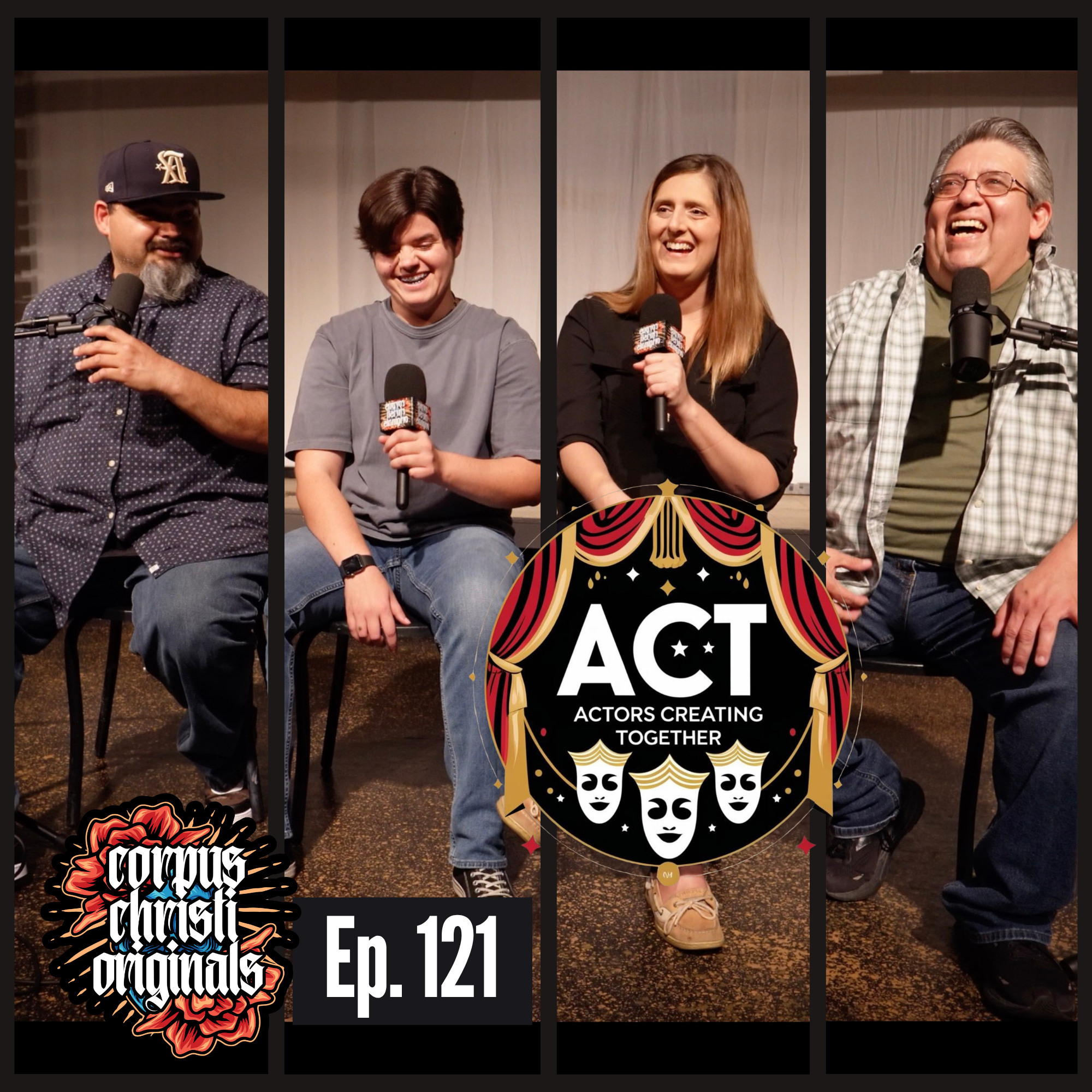
[00:00:00] Speaker A: What's going on, y'? All? It's Susilado Hernandez. Back at it again. Corpus Christi Originals podcast. Today we have act actors creating together. Go and introduce yourselves.
[00:00:08] Speaker B: I'm Mario Aguilar.
[00:00:09] Speaker C: Jessica Chang.
[00:00:10] Speaker D: Cameron Spencer.
[00:00:12] Speaker A: I'm Jesus Eladio. Already? I already just said that.
So what's up, you guys? How y' all doing?
[00:00:16] Speaker B: Good. How you doing?
[00:00:18] Speaker A: We're here at Aurora Arts Theater.
[00:00:19] Speaker B: Yes.
[00:00:20] Speaker A: Thank you, Aurora Arts, for letting us use this beautiful place. I've never been here before.
So you guys are talking to different actors. Congrats on getting to episode 10.
[00:00:28] Speaker D: Yes, thank you.
[00:00:28] Speaker C: Thank you. Very excited.
[00:00:29] Speaker A: Y' all are, like, past, like, the 90% that stop at the 10th episode, so that's amazing.
That's so. So why did you guys start the podcast? Or what's going on there?
[00:00:42] Speaker C: Am I taking this one?
[00:00:43] Speaker B: You can take this one.
[00:00:43] Speaker C: Okay, I'm gonna take this one. I think it led from. We were standing in a huddle at the concession stand here at Aurora. Just shooting.
Shooting the shit. Can I say shoot? Okay. Shooting the shit. And talking about ways to really emphasize actors and creatives and how we can really support those in the Corpus Christi area. And so one of us. I don't remember which one. Was it you?
[00:01:11] Speaker D: It was my fault.
I started this.
[00:01:14] Speaker C: Totally his fault. So then podcast was mentioned.
[00:01:20] Speaker D: I was talking to Mary because I love her stories, and they're always fun, interesting, and I told her she should be on a podcast.
And then Jessica mentioned that I should start it, and I was like, you know what?
This is an idea. And then Mario, he put all three of us in a group chat and said, like, if we actually wanted to do this, he would go out and get the equipment. And Jessica lent us her place to start our first episode. Right.
[00:01:41] Speaker A: Nice.
[00:01:41] Speaker B: Yep.
[00:01:42] Speaker A: That's pretty cool.
[00:01:43] Speaker C: That's what happened.
[00:01:43] Speaker B: So we did. And so here we are ten episodes later, outreaching to all the community around, all the theater community. It's very important, I think, that what's lacking, and at least here locally, is somebody that speaks for everybody kind of neutrally.
My. My heart belongs to Aurora because I've. I've done most of my stuff here at Aurora, so I'm favor them. You know, it's not that I don't like everybody else, it's just that this is where I do all my stuff.
But there's so many other places and outlets, not just in the community theater, but in high school theater now.
It's branched out so much. So there's so much to do in Corpus area. That we thought that it'd be okay that we put a podcast together that we could mention all these things when they happen so we can mention when auditions happen so people can go. We're trying to bring new people into the theater because if you don't, it ends up dying because people get older and they age out of certain roles that they can't do anymore. And so you need to have the younger people, younger crowd to come in to keep it going. So I think that's what we're trying to do is try promote local theater and lift everybody up at the same time.
[00:02:47] Speaker C: Yeah. Keeping it neutral. Talking about every single theater in the area, not just one.
Encouraging those who've always wanted to try theater and haven't had the courage to get out there and go for it. Encouraging them to do it, learn if they want to direct. Giving our insight on our experiences as directing, as acting, as stage managing, and showing a little bit behind the scenes of all of those aspects.
[00:03:13] Speaker A: Yeah, that's pretty cool. So, I mean, podcasting, I guess, is the thing to do to be able to get that information out there. Right.
[00:03:19] Speaker B: It's the cheapest way and maybe the more entertaining way because we enjoy ourselves, our company, and we just start talking. Some of the stuff that's not even on the podcast, we edit out because we just. We start talking and we'll go off subject.
[00:03:30] Speaker A: Oh, yeah.
[00:03:30] Speaker B: Better get back to.
So it's kind of a editing thing. So what you hear on the podcast, about 45 minutes. It's usually about an hour and a half of us talking that I have to cut down.
[00:03:39] Speaker D: Maybe over an hour now.
[00:03:40] Speaker B: Maybe over now.
[00:03:41] Speaker C: I really feel bad for you having to edit all the time because I know that is a job for you.
[00:03:45] Speaker B: So I hear the podcast about 17 times before it comes out, but it's fine. I. I enjoy it, so it's good. And like I said, I think that we all three doing this, trying to do a service to the community to. To put a light on. On theater here locally and try to build it up.
[00:04:00] Speaker A: Oh, yeah.
[00:04:00] Speaker B: That's all we're trying to do.
[00:04:01] Speaker A: Yeah. That's awesome. I love that. When I. When I had you on the podcast with Night Creature.
[00:04:04] Speaker B: Yeah.
[00:04:05] Speaker A: Night Creature production, I could tell you had like a. Like a heart for acting and all that other stuff, you know, so it's great that you're shining a spotlight.
[00:04:11] Speaker B: Well, I appreciate that. I love to do it. Something I like to do, and it just. I'm more than happy to give back whatever I can yeah, if it's me helping backstage, I'm happy doing that. There's me on stage. I'm as well. So they as well are. So I worked with Jessica handles last production. We did apply spirit. She was directing, I was assistant directing. And got to know Jessica because she's new to the city. She's only been here a couple of years. What three or four years.
[00:04:37] Speaker C: Just now celebrating three years of being
[00:04:39] Speaker B: in Corpus Christmas stage from Oklahoma. So we didn't know each other coming into that. I was just the stage manager for some. She was assistant directing the year previous. And so we got to know each other and she asked me to help her and I was honored for one. And I learned so much from this because she just got a lot of. A lot of knowledge of what's going on. So it helped me build my resume.
[00:05:00] Speaker A: Yeah.
[00:05:00] Speaker B: So. Because I want to direct eventually too. And like I said, I learned a lot from Jessica.
[00:05:04] Speaker A: So how did you, how did you land on. How did you in end up in Corpus? Like looked at a map and pointed like here it is or
[00:05:15] Speaker C: so I'm from Tulsa, Oklahoma and so my husband landed a job down here. They, they said, hey, we really want you here. Then they paid for us to move here. So we're like, yeah, okay, sure, why not?
And so that is how we ended up in Corpus is through my husband's employment. So it is. No, it's been amazing. I love that the beach is only a 10 minute drive away.
Absolutely. Phenomen did leave a theater community in Tulsa. I was a co founder of a community theater there that was in the process of getting ready to thrive and absolutely amazing opportunity. And so I left that behind when we made the move.
And then it took me almost two years to find a theater family here and Aurora adopted me. And so my heart is here also. Again, I'd love to work if any anybody else out there is watching. Definitely would love to work with some of the other theaters here in town and just really shine a light on the theater community and actors and.
[00:06:19] Speaker A: Yeah, and so you're in the directing aspect of.
[00:06:23] Speaker C: Directing's my favorite part of it. Yeah. And so straight plays primarily. And then if I act, I act straight plays.
[00:06:30] Speaker A: Okay, cool. And you, sir? I'm sorry, I forgot your name.
[00:06:33] Speaker D: Cameron.
[00:06:33] Speaker A: Cameron. So what, what do you do in the scene or for the scene or you. Seems like you're an actor or actors or whatever you call it.
[00:06:40] Speaker D: I'm being rude. More of an actor.
[00:06:43] Speaker A: Okay.
[00:06:43] Speaker D: Yeah. My first show here was A Christmas Story where I was Just adult ensemble.
But I auditioned for the late Peter Lopez for West side Story, and I got in and it was just so much fun. When I'm not on the stage, I would help out with concessions.
[00:07:00] Speaker A: Wow. Yeah. Oh, man. What's that feeling like when you're on stage and you see the crowd?
Captivated the crowd, like, is that why you keep coming back or.
[00:07:08] Speaker D: That's actually why I keep coming back. Yeah. It's amazing to feel the audience's energy while you're on stage and like, like them watching the show. For me, it's just like escaping the world that's outside.
[00:07:21] Speaker A: Yeah.
[00:07:22] Speaker D: Like, you get to live in an entirely different world, become a different character.
And it's awesome seeing how the audience can connect with a lot of the characters that are on stage.
[00:07:33] Speaker A: For sure. How do we get. How do we get people from their TV screen, from Netflix to come out here? You know, I mean, is that, Is that an ongoing struggle for you guys?
[00:07:42] Speaker B: To be quite honest with you, it's been so much.
I think we're getting. We're seeing a change right now. I. I am seeing. The last couple years, they're streaming a lot more plays on, on, on, on. On TV now. There's a lot of streaming services out there.
[00:07:55] Speaker C: Musicals.
[00:07:55] Speaker B: Musicals. And, and they'll scream that. They'll. NBC even did like a lot. They've got a couple of live place. So those are things that are, are get into the people that watch TV all the time, say, well, you know what? I might be wanting to go see that live somewhere and go look locally in their community to go to go see like, they come to Aurora, they go to harbor and see the place. I think another thing is, is that being able to put good and new shows out there to people that people want to see.
There is a lot of issues with getting licensing and stuff for plays, especially some of the new ones. I mean, you'd have to have them. It's not adventure, it's not easy, and it's not cheap anyway.
Even the ones that we do here cost a lot of money. Is the reason why to pay for license, to pay for licensing music, you got to buy the, the books for white scripts. There's a lot of things involved. So. And then you got to pay a percentage of the seats to them too. So all that's all put together and the price of what you have to pay.
[00:08:49] Speaker A: But.
[00:08:50] Speaker B: And like I said, it's. It does a great. If we could sell out every night, it work. You know, every play will work.
So you have A minimum you have to actually sell to be able to recoup your money.
[00:08:58] Speaker C: Definitely support the local theaters. If you see, there's the Port Aransas, Aurora, Harbor, Rockport, if they're the ccisd. CCISD puts on some phenomenal shows they're about to do. They're getting ready to do Greece.
And the only way that the doors can stay open is by guests coming through the door and putting butts in chairs. So highly encourage.
Find a show that you think you might like or who cares if you like it or not, just go support them and have fun. If they're doing a drive and doing some fundraising or you want to support and donate money to the local theaters, highly encouraged to keep those doors open and keep creatives on stage.
[00:09:43] Speaker D: And if there is a show that you do want to see, then email, call, say, hey, I would really like to see this show end maybe, but can do it.
[00:09:52] Speaker B: Yeah. If it's available and it's able to be.
I was licensed for the. For the community, they will take into consideration. That's harbor and that's here. Aurora as well. I'm sure Port Aransas and Robert are the same way. But the good thing, what I've been noticing, there's a lot of different types of plays going on, so we are seeing a lot of musicals because that's what people really like to hear.
But a lot more straight plays now, and I kind of like that, too, because there's a little bit of a difference. You don't always have a musical. I love musicals. They're great. But there's, you know, you want. It's kind of a different thing once in a while. And all musicals once, all the time will just get kind of monotonous.
So like I said, it's just something that we want to try to push for. Trying to. For people like Mary here, who owns Aurora, you know, she's a sole proprietor, so she is not a nonprofit, so she's got to put money out herself and sponsorship and those kind of things. And so it's important to sell most of seats in this theater so that she can recoup just the money that she gets to keep going for the next one.
So I really hand it to Mary. This is going on her 16th year here, keeping it going. And so I really applaud her, how much she's done. So without her, all three of us wouldn't have any kind of thing to do right now with the theater because it wasn't for her. So I. I thank her every Time I see her, so.
[00:11:18] Speaker A: Oh, yeah, you got. You gotta love to do it. I mean, to be here.
[00:11:22] Speaker B: Oh, yeah.
[00:11:22] Speaker A: I just got into, like, the comedy scene and that's.
[00:11:24] Speaker B: Yes.
[00:11:25] Speaker A: I saw the beast in itself, you know. That's exciting. Yeah. Yeah, for sure. It makes me think about. It seems like a lot of the stuff is word of mouth, the community. As far as coming out here, how much of an impact do you think you need to make or do you think that social media has on getting the word out?
[00:11:43] Speaker C: Social media, I think in this day and age is everything.
It's absolutely everything as far as affordability as well, for advertising and getting your word out.
I wish we could all, you know, rent billboards and. And put words out by billboards. But. Or commercials. But even commercials are a dying art.
[00:12:03] Speaker B: Yeah.
[00:12:04] Speaker C: With streaming services nowadays. So social media is extremely important.
Getting. Having those followers and getting the word out and. And just talking about the positive aspects of.
Total loss of words just now.
[00:12:23] Speaker A: It's all good.
[00:12:23] Speaker B: Like.
[00:12:24] Speaker A: Yeah, for sure.
Because. And then it takes me back to your pod, your podcast. Right, right. Obviously. Why y' all started that. Is that some of the reason why you. You guys began doing that? I mean, do you.
[00:12:34] Speaker B: I think that. That it was just something that was a spot that was not.
Nobody has really touched it yet here locally, at least. I don't know if I might. There might be another person here in town who does theater, maybe local events and stuff, but specifically community theater.
No, I don't think there is any. But if there is, we're welcome to come.
[00:12:54] Speaker C: Please.
[00:12:56] Speaker B: Yeah. Give us some hints and pointers because we're always learning. I always want to be learning about the. About what's coming up and going. So we're right now in an audio phase where we're just doing the audio. We want to go like, what you're doing here is with a video.
It's just. And I'm sure you're. Well, it costs money and. And those kind of things. So we're all doing it out of our pockets. We're not. We have any sponsorships, anything like that, but if you'd like to sponsor.
[00:13:16] Speaker C: If you'd like to sponsor,
[00:13:20] Speaker B: you can hit us up on Facebook if you want to sponsor. But the whole thing is that we. We do it because we love it and we take our time to do it. And.
And so I. I think we're doing a little bit of a service. I mean, yes, we. We do share on Facebook and. And all the. All the other platforms so we can advertise But I think having a little bit of a. A talk where we can all talk about a subject and specific to the theater group because there's a lot of things that, that new actors are worried about. I don't want to go autism. I'm afraid this is going to happen. Oh and we can alleviate some of those, those things that make people afraid of audition. We can get more people to come in. So I think that that's one way we can help.
[00:13:55] Speaker C: Definite ultimate goal. One of those ultimate goals being that encouragement of getting out and trying something new. Overcome those fears and just sharing inside tips and interviewing as many people as we can with those inside tips to
[00:14:11] Speaker A: share and yeah too if you interview those people, they'll share it with their friends obviously.
[00:14:16] Speaker B: Oh yeah, we've we got a lot of help from Aurora and, and Harper and, and all the people that are in the shows that we promoting. They share on their side. So we've got a lot of people that, that even I never have heard before asking to, to, to follow the, the side. So it's building and I think that, I think once we get to the video and they see a face.
[00:14:39] Speaker A: No for sure. No. I'm glad you brought it up because I think that because historically podcasts or audio right now they're just video.
Like that's the standard now and I definitely think it would, it would help out what's some of the things. Let's talk about like the community aspect with some of the people outside of the, the actor creative scene that you guys are in that the community outside doesn't get understand know about you guys that you want for them to maybe understand catch about what you guys are doing.
I think like, I think about arts, you know what I mean? And how sometimes arts can just be a thing that you learn in high school, whatever and then eventually you get into your career, you kind of just forget about it. Some people, not all people, you know what I mean? So I'm trying to figure out what you guys want. The people that are past that stage, maybe they're not around you guys. Like what do I want for them to, to learn to know what some. You know what I mean? What, what, what don't they get about it? You know what I mean?
[00:15:43] Speaker D: Yeah, I mean I had some friends ask me what it's like acting on stage and a lot of them just assume it's oh, you're playing dress up as an adult. You're an adult playing dress like seriously. No, it's not, it's not just that. It's a way to not get. Not only get out of your comfort zone, but it's also a way to make new friends, form a community. Oh, yeah, leave the stress behind.
It is a family, big family.
And it's family that will last a lifetime. Friendships that last lifetime.
And like I said, it's getting away from stress, from work, from life.
It's so much fun. And a lot of people think, oh, other people are judging you because they're new. They've done. Or they've done this for a while. It's like, no, nobody's judging you. We want to help you. You're the only one judging yourself.
[00:16:37] Speaker C: And most directors will aim towards getting at least one, two or three brand new actors that have never been on the stage before.
They want first timers to come out and experience Bonnie and Clyde right now. One of my friends I had made recently, I was at her house and she was singing and I was like, have you been on stage before? She's like, I've thought about it. And I was like, bonnie and Clyde auditions are next week. I really think you need to go audition for Bonnie and Clyde.
She's in love with the theater now. I think she even came and auditioned for the next show yesterday or the day before. And I can't wait to hear if she got a role. I'm sure she did. She's phenomenal. But that's the first time she's ever done theater. And then when we were in a show last summer, I was assistant directing one of our characters, he dropped out and we needed a replacement. And again, there was another friend of mine who I'm like, you know what? You've got the looks for the role that we need to fill.
Have you ever been on stage before? He's like, no. I'm like, you want to try?
He's like, you know what?
Sure.
And brand new experience for him and he blew it out of the water. He did such an amazing job. So one of the. To answer your back to the round of the question of what we want people to know is get out there, try it. If you've ever considered it, the only way this art is going to stay alive is if we get newcomers.
Get out there and just do it.
[00:18:18] Speaker A: Yeah.
[00:18:18] Speaker B: We always tell people that, you know, that not every role is for every person.
A director has a.
A person or a will look on mine. And they don't just because they're. Excuse me. Because they're just friends or they know that person, but because they have a certain look or something. That they want to see. And sometimes you could do the best you can. And it says, I mean, you're going to get the role. And then you just have to learn to know that it's not personal.
I think at the very beginning, when I first started, I took it personally. And, and that's where we, because you take, you take it, hey, what did I do wrong? I could have better. Why didn't I get this role? And, and you get kind of upset with yourself because you put yourself out there.
But I learned from that. I learned what not to do in order to prepare myself. I learned to, hey, find out what the information, what you're doing. You, you know, there's Internet now, you can Google all these things now that find out just the basics about the part. So that way you don't go in there flying blind. And then you worry about how I'm going to get this across and, and get the part if you don't know anything about it. So I learned a lot of things to do. So the next time I, I did get an audition, I got the part because I learn from that mistake.
[00:19:23] Speaker C: And these are the types of things that, what we've been sharing here with you today. These are the things that we talk about on our podcast all the time. And so if it's something you're interested in, follow us. Come listen to our podcasts as we make them because this is the way our conversations are consistently. Just talking about first hand experience, interviewing those that have had the experience.
If you would, if you're in the theater community here and you would like to be a guest on our show, reach out. We would love to have you if you've got a specialty.
[00:19:54] Speaker B: Yeah, exactly.
[00:19:55] Speaker A: Yeah, for sure. And like my podcast is about shining, shedding light on different aspects of the community, obviously. And I like that you guys are here talking about this. And of course my mind goes into different things of like your scene and how it is and what the audience is like and stuff like that. Because it seems like maybe the audience could be just your fellow actors or directors and stuff like that.
And then it's like, how do you get more people that are not in that circle to come and enjoy, you know what I'm saying? And like what you mentioned about your friends thinking that, oh, it's like this, therefore I'm not gonna go because they have a preconceived notion about it, you know what I'm saying?
But it's, yeah, definitely. So what, what makes your podcast different from other creative interviews?
[00:20:43] Speaker C: We're idiots.
[00:20:44] Speaker B: We don't know everything and we never know it all. I think our first episode was the first thing that we don't claim to be professionals and, and be critics and know everything about everything to do with theater. But I think as a community, we get to get in as we go on. Hopefully we will take more questions from the audiences about what they want to talk about and then speak about those things. Because there's a lot of things to go along with acting that people are afraid of.
Wanted to start, you know, the audition is very. It's a big hill to climb to get past. You're not being afraid to do it. Sometimes it's a three part thing. We have to learn to sing, dance and act.
[00:21:21] Speaker A: Oh.
[00:21:21] Speaker B: And so it's a triple fit. Like if for this last. The show's coming up or not, you know, Frankenstein. That's a. You have to know all those three things as opposed to a straight play just acting. Right?
[00:21:30] Speaker C: Yeah.
[00:21:30] Speaker A: Memorize your lines.
[00:21:31] Speaker B: Memorize your line. And sing and move and it's not easy.
[00:21:34] Speaker C: That's an understatement.
[00:21:35] Speaker B: It is not easy at all. Well, this last play, she's laughing because the last time we had was a lot.
[00:21:42] Speaker A: I'm glad she's. She's like, good, like coming out, being herself.
[00:21:45] Speaker B: That's what I'm looking at. She, she understands what I'm saying. Because the last play we did was a lot of dialogue.
[00:21:50] Speaker C: A lot.
[00:21:51] Speaker B: And it wasn't a musical. So there's no music and it's just dialogue, man. So. And it was, it was fun because, you know, it was up and down with laughter and stuff. But it's just a lot to memorize. And I, I really do respect anybody who can sit there and memorize 130 some pages.
[00:22:06] Speaker A: Oh, for sure.
[00:22:06] Speaker B: Of a play. It's not easy at all.
So kudos to anybody could do it.
[00:22:12] Speaker A: Yeah. So how do you decide what belongs in an episode?
[00:22:17] Speaker D: Well, vote. Well, yeah, we vote. We can talk about it beforehand too.
[00:22:21] Speaker B: Yeah, we do have maybe beforehand. What do you want to talk about today?
[00:22:26] Speaker D: Sometimes it takes us like 30 minutes.
[00:22:28] Speaker C: Yeah, 30 minutes to decide.
[00:22:29] Speaker B: It does. Sometimes it does.
We'll start recording, then go off and then let's start again because we went to a totally different subject. But it's good that we all have ideas that we want to bring to the show and talk about because we all are in different things that we do. Cameron's an actor, director, I'm an actor and I did some stuff in the back of the stage management Stuff too. So those are all things I could bring. If anybody has questions for stage manager, we want people to want to go volunteer. Even if it's not acting, they need a lot of people to work behind the scenes. There's a lot of texts that are needed if you know anything about lighting, sound, effects, choreography, costume, painting the set, makeup, painting the set. There's so many things that you could volunteer without having to be on stage, but be a part of this community because we value those people, those people. Without those people to make the stage that we're seeing behind us, that takes talent. I mean, it looks like it's put together the way it just would, but that's the way it's set supposed to be, but it's the talent that goes into making these stages. Every show at Aurora, I mean, I've seen it done in other states, other places, but here, Aurora, I've seen it every. The last three shows, I've seen it just changing.
Our last set was a house and it's totally different than this. And it's just amazing what a set does. So without those people, the actors couldn't do what they do. We wouldn't have a crowd that wanted to come see this show. So it takes a whole community of these people to get the show to go and get off.
[00:23:57] Speaker C: I can't remember the current question.
[00:24:00] Speaker B: And this is what we do.
We just keep talking until.
[00:24:03] Speaker A: No, it's like, yeah, if y' all are going to keep talking, if y' all go whole hour, I'll sit here
[00:24:09] Speaker B: and not say nothing. That's my whoop.
[00:24:12] Speaker A: I'm just trying to make an hour with you guys.
[00:24:14] Speaker C: Please remind me what the question was.
[00:24:16] Speaker B: I'm like, I'm sorry.
[00:24:17] Speaker C: You'll have plenty to edit, I promise. Plenty.
[00:24:20] Speaker A: Oh, sh.
What makes us successful collaboration.
[00:24:24] Speaker C: Oh, that's what I was going to say. Okay. Because I had an answer, but I forgot what the question was so then I couldn't remember my answer.
One of the things that we do want to. To do as frequently as possible is interview the directors of the current show. We try to do that as much as possible in the area. So if you're going to be directing a show, hit us up. We'd love to interview you.
[00:24:48] Speaker B: Yes.
And, and like I said, Aurora and Border, Anis and Harper have been very accommodating with their, their marketing people contacting me and letting me know, hey, so and so is can be interviewed and, and they're let us go and watch the preview so that I can review it.
The Show. I plan to review every show that I go see or down and I'm trying to make it to all the shows. So even if it's out there in Port Aransas or in Rockport, I try to get out there to watch it so that I can put a review out there. It's just like I said, the last couple of months was kind of slow because we were doing Glad Spirit and so we took a little bit of a hiatus of the podcast between episode nine, ten, but we're back. We're going to do it regularly.
[00:25:26] Speaker D: Little hiatus.
[00:25:28] Speaker C: Just a little two or three months.
[00:25:30] Speaker B: You know, it's not like we sat down and went to the beach and drank margaritas. We were working, we were doing.
[00:25:35] Speaker D: We don't know that.
[00:25:36] Speaker C: I don't know about you, but I did that a couple of times, but I did not know and we were busy.
[00:25:40] Speaker A: Y' all recording the same, same place
[00:25:42] Speaker B: every time or we've recorded here sometimes in the, in the, in the lobby. And most times it's at the most.
[00:25:50] Speaker C: The time it's in my dining room.
[00:25:52] Speaker B: Yes.
[00:25:52] Speaker C: The. At least the follow up stuff. The interview we tried to do at the theater.
[00:25:55] Speaker B: Yeah, we'll go to harbor and do the interview over there.
[00:25:57] Speaker C: Yeah. And then the, the rest of it. Yeah, the prologue and epilogue.
[00:26:03] Speaker B: We didn't do it at our house.
[00:26:04] Speaker C: At my house.
[00:26:05] Speaker A: Yeah. So creatively, do you guys have differences in create talking? I guess because. Okay, so I used to play music right in at Harbor Playhouse. I was playing guitar and I did a Godspell. No, no. Oklahoma. Or something like that. Anyway, they asked me to do Rocky Horror Play.
But like, I've kind of shown the type of person I am. Like, I told him no because of the content that was in it. I really didn't want to like expose myself to that type of stuff. So I had to tell him like. Like, I can't do it. You know what I mean? But I'll do this or whatever the. Is there some types of differences that y' all have either with. Amongst each other, amongst maybe you're the person that's on your podcast. I'm just trying to get those thoughts out, you know what I mean?
[00:26:51] Speaker C: No, I think that's a great question.
I think for the most part we're pretty much aligned on a lot of things. I don't. We haven't really had any arguments on what will or will not go on the show.
We just sort of feed off of each other.
[00:27:07] Speaker D: Mario just won't let us swear on the podcast.
[00:27:09] Speaker A: Oh, you serious?
[00:27:10] Speaker D: We're censored.
[00:27:11] Speaker B: We're trying to be as positive as possible. I think about. We get to the 20th episode, it's going to get kind of. It's going to get explicit. We're going to put the little explicit thing on there.
[00:27:20] Speaker C: You should have an explicit episode. Just.
[00:27:22] Speaker D: I'm just gonna let it loose on one day.
[00:27:24] Speaker B: There'll be a lot of beeping.
[00:27:25] Speaker A: It's so, so weird because, like, if you do it clean, like, you'll reach more people. It's weird.
[00:27:30] Speaker B: Yeah.
[00:27:30] Speaker A: And, like, I mean, there's nothing wrong with swearing. Like, you can swear all you want. Like it. But I think there's. There's a cap. You know what I mean? And then it sucks because if you want to reach more people, you have to not do it right. You know what I mean? And it's like, how it's constricting. You know what I mean? Do you see it like that? Is that why you're. You mentioned that?
[00:27:49] Speaker D: I swear like a sailor when I'm not on the podcast.
So it's very difficult for me to hold back, and I do try my best.
[00:27:58] Speaker C: You do a good job.
[00:27:59] Speaker B: Yeah.
[00:28:00] Speaker D: The reason being I sit in my car outside of Jessica's house. I let it loose before I go inside.
[00:28:05] Speaker B: She goes to all the seven, and she just.
He just goes through all of them, right?
[00:28:09] Speaker D: The seven deadly phrases.
[00:28:12] Speaker B: Yeah. The only reason why is because that way we, like, said so we can reach more people, I think because there are kids who are in theater and we want to include them because those are our next people who are going to come. There's our next bonding ties.
[00:28:25] Speaker C: Really good point.
[00:28:27] Speaker A: That is a good point.
[00:28:28] Speaker B: And if we don't get them at the younger age, it's. I mean, I. I was very blessed because I had a theater back from when I was in junior high, but once I got to high school, I got out of that. And then afterwards, I didn't do anything until I turned 50 and came over here. And then somebody brought me. I started doing film and doing all this stuff, but then I came over here, was introduced to it, and I just loved. I love that it was spontaneous. Anything can happen. Like, I'm right there live talking. I can mess up, and I got to fix it. I can't. I can't take a cut and just do it over again. You don't do that in a play.
[00:29:00] Speaker A: It's.
[00:29:00] Speaker C: It's.
[00:29:00] Speaker B: You mess up. You got to figure a way out of it right where people are watching.
[00:29:03] Speaker C: There are some amazing bloopers. Live on stage. Another reason to go watch live theater is the blooper.
[00:29:08] Speaker B: Never know what's going to happen.
[00:29:09] Speaker D: Each night is completely different.
[00:29:11] Speaker B: Yeah. So that's. A movie is edited, so it looks pretty and nice and perfect. Right.
This is not that. And I learned that really fast. And I think that was really what attracts me to this part is the adrenaline rush when you come out here. And it's like when I first started, I was doing Rocky, and that was not until the set I was not coming out with Dr. Scott trying to come out to the second half. So I'm on the back there anticipating this way. So it's just kind of a drilling going. And finally you get to go out there and it's like, boom.
[00:29:38] Speaker A: Wow.
[00:29:39] Speaker B: So, to me, I just love it. I love that.
[00:29:42] Speaker D: I think my favorite part about being on stage is a lot of the actors will try to make other actors break on stage.
[00:29:50] Speaker B: That's what you know before your friends, because they try to get.
[00:29:52] Speaker C: I was randomly laughing just now when we're talking about this, because I cannot not laugh when I think about it. And this recent show, one of the characters throws a sandwich, a cucumber sandwich, behind her. She has this epiphany, and she throws the cucumber sandwich. Well, one night, one of the other actors was walking behind her. It actually happened, like, almost right here in this spot. Actors walking behind her as she throws the sandwich and gets him right in the face.
The cucumber sandwich just, like, smeared. And for the cast to.
[00:30:29] Speaker A: It's a cucumber sandwich, bro. That's weird.
[00:30:32] Speaker B: Well, that was part of it.
[00:30:33] Speaker C: Have you never had a cucumber sandwich?
[00:30:35] Speaker B: Yeah, I don't like them.
[00:30:37] Speaker A: I don't think I've ever heard of one.
So just cucumber, slice of bread. I'm not saying no.
Okay.
[00:30:44] Speaker C: No. It's like you do like, a chivey creamy.
[00:30:48] Speaker B: If I fill it up with cream
[00:30:49] Speaker C: cheese, like a dill cream cheese with the cucumbers on bread, and then you cut off the edges. You can't.
[00:30:57] Speaker B: Cucumber? Yeah.
[00:30:59] Speaker C: You slice the cucumbers really thin.
[00:31:01] Speaker B: They can't be wet. You let him start. Yeah.
[00:31:03] Speaker A: My inner big boy just came out right now. So I'm getting hungry. I'm like, I need to try that out.
[00:31:07] Speaker C: I'll send you the recipe after this.
[00:31:09] Speaker B: Well, it's kind of funny because one of the actors were like, she'd eat.
[00:31:12] Speaker C: She has eat, like, five of them through the social.
[00:31:15] Speaker B: She's eating them, and so she eats them all. So it's kind of funny, but she
[00:31:17] Speaker A: threw it in the back, hit the first.
[00:31:18] Speaker C: Hit the guy hit the guy in the face. It's supposed to, like, go all the way back and, like, hit the wall and he walked right by. So, yeah, bloopers happen. And the. To keep a straight face just did not happen that night. So it was.
[00:31:31] Speaker B: Yeah, they got.
[00:31:32] Speaker A: Well, I guess that was a part of your resume too, like learning how to move on if something messes up.
You know what I mean?
[00:31:38] Speaker B: Yeah, you just kind of talk.
[00:31:39] Speaker C: For sure.
[00:31:39] Speaker B: You just have to talk your way into where you. And this is why it's very important to know where you're going and seen is that.
Know what your character's got to do next. The way if you do lose your space, you can find your way back knowing what the story is.
Sometimes a bomb that I have run into. Sometimes when people do that, they forget that the last line is a cue for the next person to speak. And they're waiting for that cue line to be said a certain way. And you don't say it right, and you're like. Then you get lost. So you got to worry. You got to really pay attention. So it's. It's very important. Unless it's something you've done a million times, especially that first night when you out there, it's really.
You got to know where you're going, what you're doing, because somebody else depends on you to do the right thing, to say those words that they need so they can do that.
[00:32:22] Speaker A: Yeah, I find it interesting.
[00:32:23] Speaker B: There's a lot of.
[00:32:24] Speaker A: Yeah, I find it interesting if you have like, three shows in a day or two in a weekend or whatever. Like, each one is different.
[00:32:29] Speaker B: Yeah.
[00:32:30] Speaker A: Like, that's very interesting.
[00:32:31] Speaker B: Yeah. Just because of the. It could be the crowd not into it.
[00:32:34] Speaker A: Yeah.
[00:32:34] Speaker B: They're not laughing. And so you don't feel. You feed off of that.
[00:32:37] Speaker C: Oh, yeah. The crowd energy makes a world of difference on how the actors do during that set. For sure.
[00:32:43] Speaker A: Pretty cool. So do you guys prepare for. How do you all prepare for interviews with. With people? They do. I interview somebody every episode or.
[00:32:52] Speaker B: Yeah, every episode of somebody Chat.
[00:32:53] Speaker C: GPT question recommendations.
[00:32:56] Speaker A: For sure.
Yeah.
[00:32:57] Speaker B: Yes, I'm with you.
[00:32:58] Speaker C: Yeah. Thank you. ChatGPT.
[00:33:00] Speaker B: Because you kind of. I mean, you put all the information what you wanted to do and you. But it's because if not, I'm going to miss a question that I want to ask.
And we usually get a bunch of them, and we don't usually ask every question, but it's Good to have a good amount to be able to over prepare. Yeah. Then under prepare.
[00:33:14] Speaker C: So we also like to try to do a variety and not make it the same questions for every director for every show, because there's different perspectives. And if we know that that director is known for a certain style, then focus those questions on style of their thought process and what their background is. So we do mix it up for whoever it is that we're interviewing. But yeah, mostly chat. GPT.
[00:33:40] Speaker B: Yeah.
[00:33:40] Speaker A: Yeah. So when you're talking to and interviewing those people, what do obviously you do try to do, like you just said, a different interview style, I guess. Interviews, questions or whatever. What's something that you want to get from them, like every time?
Like, do you want them to talk about just the show that they're putting on or like. You know what I mean?
[00:33:59] Speaker C: No, never just the show.
[00:34:01] Speaker B: Yeah. Because that's. We. We do.
That's why they're there is to promote the show. But it's. It also be able to keep people listening is to get more in depth on what their knowledge is. A little deeper than just the surface, what we know. And so like, even like this last with Brian Davis, we interviewed the director from Hunchback and Notre Dame, who's. They're doing that at Harbor. I think it's the last week, but they're doing it in Harbor. And he sat down and yeah, we get to those top questions, those basic, you know, how is it to direct? But then you start asking about like questions like auditions. And then he started getting more into depth on what his process is and. Wow. What he's thinking about. Every director has a process that they use to be able to do to see if the show that they wanted to do. And with him, he was telling us that he had an issue because it was a show he's never done before, and it's a big show with a lot of music to different styles of music kind of going over each other. And I was very impressed. I mean, I saw the show. If you haven't seen it, y' all go see it. It's really good that. That he could bring all these people together and do that. And that's the power of a director and be able to interview them and get that out of them. Yeah. In the 20 minutes that we have. Oh, wow. So we have go back and look some of our archives. We just kind of like ask the questions. And so I'm just. We'll go. We'll just go. Lori Hoffenmeyer. Yeah, I remember that one. She Was she just. We asked a question. I think I asked her three or four questions, but she took off into all these things, talking about what was great information because she gave amazing. So much detail and stuff.
[00:35:25] Speaker C: She also. She has. She's about to have her masters.
[00:35:27] Speaker A: I got a question. Do they. Do they talk most over.
[00:35:31] Speaker B: Over you?
[00:35:34] Speaker C: I'm sorry, Cameron.
[00:35:35] Speaker B: Cameron has.
[00:35:36] Speaker D: Yes, they do.
[00:35:39] Speaker C: But Cameron has one of the most important things on every show that we have to have on every show.
[00:35:45] Speaker B: Right.
[00:35:46] Speaker C: And that is Cameron is our jokester,
[00:35:48] Speaker D: and I'm the biggest jokester, and Cameron
[00:35:51] Speaker B: provides the comedy at the end.
[00:35:55] Speaker C: The dad joke.
[00:35:56] Speaker B: Yes, the dad joke of the day.
[00:35:58] Speaker A: The dad joke of the day.
[00:35:59] Speaker D: Yeah, that's a joke.
[00:36:00] Speaker C: The most important.
[00:36:01] Speaker D: The joke at the end of the podcast. Like every single one.
[00:36:04] Speaker A: Wow, that's so cool. Like a ritual type thing.
[00:36:08] Speaker B: So we don't have that.
[00:36:10] Speaker A: Yeah.
Okay.
[00:36:11] Speaker B: You just talk all the time. Well, I'm gonna say I talk all the time. Jessica does its answers and then Cameron does it.
[00:36:19] Speaker A: Here's my. My ritual, I guess one that I try to do every episode. Which. Which HEB is your favorite? HEB or which is your least favorite HEB in Corpus?
[00:36:30] Speaker D: I actually worked at an HEB for
[00:36:32] Speaker B: a while, so here's some bad stuff coming right now. Ignorant.
[00:36:37] Speaker D: I can't talk bad about the managers I've had because they were amazing.
[00:36:41] Speaker B: Just the stores.
[00:36:43] Speaker A: Nice.
[00:36:47] Speaker D: But I think.
[00:36:48] Speaker A: And of course you don't have. Like, sometimes I'm like, dude, I don't know if they have to answer or if I. They're expecting me to answer or whatever.
[00:36:56] Speaker D: But I can't say the store I worked at was my favorite. It's the South Alameda one.
[00:36:59] Speaker C: The one.
[00:36:59] Speaker D: The Medical District.
[00:37:01] Speaker B: Oh, yeah. Yes.
[00:37:02] Speaker D: That's when I worked at.
[00:37:03] Speaker A: Oh, yeah.
[00:37:04] Speaker D: I like that one because it's. It's cozy to me.
But sometimes that HEB doesn't have what I'm looking for, so I have to go to a different one.
[00:37:14] Speaker C: I was in a smaller one somewhat.
[00:37:16] Speaker B: Yes.
[00:37:16] Speaker C: Okay. See, being new to Texas. H E B. Brand new to me three years ago. And I'm in love with heb and my favorite is Saratoga and Staples.
[00:37:27] Speaker A: Oh, yeah. For sure.
[00:37:28] Speaker B: Mine too, actually. But I did grow up on the cost stores one before they built the new building. Now it was the old. The one customers I used to. We used to always walk there.
[00:37:39] Speaker A: Wow.
[00:37:39] Speaker B: To go get stuff at HEB from there.
[00:37:41] Speaker A: Was it in the same location?
[00:37:42] Speaker B: It was in the same room. It was kind of turned the other way on the. It was Facing the castors, facing the Galahar street. And it was just one strip. And they had like, the training thing there. And they also had. Their credit union was there. They had an HBC in there. So I'd always go over there. I think I worked at HB a long time ago, but it was the video store video central, so I did work for them. So I would. Had a count at the heb. Crazy. So I would go there all the time. So that's kind of why was one of my favorite. As I said, when I grew up around that area, that was the one we'd go to and stuff. So go hb.
[00:38:13] Speaker A: Yeah. So regarding y' all's podcast. Sorry, I always. My ADD is showing, man. I switched directions like, so crazy.
So when y' all are. So what happens when a conversation goes where you don't expect it to go?
What do you do? Yeah, what do you do when a conversation goes in an unexpected direction?
[00:38:30] Speaker D: Edit.
Sometimes you try to find a way
[00:38:34] Speaker B: to bring it back. Yeah, we never hear that party kids. It gets chopped and goes away.
We don't really have that so much. I think it's more the.
And the dead air and the kind of space between. I kind of take some of that out and make it a little tighter.
[00:38:46] Speaker A: Cool.
[00:38:46] Speaker B: And we save about a minute or two with just between the three of us.
[00:38:50] Speaker C: Man.
[00:38:50] Speaker A: You know what? I was listening back. I can't really tell that there's. It seems like it's just one, I guess because I like, that's how I do it. But it seems like just one long.
[00:38:57] Speaker B: Yeah, well. Yeah, I just take a good editor. Yeah, well, as. Just not me. It's a computer. I just. I just. I'm in there and I. And it's like. It's not always right. I mean, my sound is not perfect. Our. Our mics are kind of the one I use for some reason. Mine's always.
[00:39:11] Speaker C: Your life has been mean to you lately.
[00:39:13] Speaker B: It's like every time it's like they have the best mics and I get them all. I mean, like, I'm talking in a can down the street or something.
[00:39:18] Speaker D: We had difficulty the. The last episode trying to side.
[00:39:21] Speaker B: We're up. I apologize.
[00:39:23] Speaker C: All your fault.
[00:39:24] Speaker D: It was the wires.
[00:39:27] Speaker B: If you want to help sponsor our show to buy new wires, you're welcome
[00:39:31] Speaker C: to do so some equipment so we can start doing video like you do. This is some nice down here.
[00:39:35] Speaker B: Yeah, yeah, yeah.
[00:39:36] Speaker A: Yep. Get it done.
Why. So why was it important to create a podcast in Corpus Christi?
[00:39:43] Speaker C: Because this is where we live.
[00:39:44] Speaker B: Yeah.
[00:39:45] Speaker A: Well, do y' all interview people outside of Corpus?
[00:39:48] Speaker B: Oh, we. We really don't. Just because I think right now we're we or everybody's focused here, community wise. All our information news is here local.
I don't think we really talk about national stuff. We do talk about the place that come through into town. Like tonight they're doing Hatestown.
[00:40:05] Speaker D: I think it's Hadestown tonight.
[00:40:06] Speaker B: It's tonight. That's a national.
[00:40:09] Speaker D: The Hillard Center.
[00:40:10] Speaker B: They. They do a tour of. Of shows that are on Broadway or still in Broadway. And they tend to do like a national story, a regional theater tour.
And so they have actors that are not the main actors, but there are actors that. The traveling actors and they. And they go around all the cities and do the.
[00:40:26] Speaker A: So is that some of, like, some of the. I guess the goals for people locally to want to do that?
[00:40:30] Speaker B: Well, that's one. That's a step up higher then. Yeah, I mean, that's what.
[00:40:33] Speaker C: I mean. It is.
Correct me if I'm wrong. I mean, it is Broadway on tour. They are Broadway hired actors, not from the main original cast, but for the touring cast to do an entirely different audition process for the ones that tour.
[00:40:49] Speaker B: And I've seen them to where we've had when I went to go see Moulin Rouge in Houston, that was a touring one, but there was an actress that was there, I believe she kind of got stepped up to the Broadway version some. Sometimes when they go on tour, they used to work out all the stuff there. It's kind of like minor league baseball where they do all like that. They get up the hooks, but then they can get pushed up to the Astros. Kind of same thing with this. They will do this national tour, get it down. And then if they need a person up there to fill in for someone might be sick or maybe gone for a few days, they go on the field of place.
So they always have on, you know, understudies to be able to do all that. The show has to go on. And so there's a lot of money at stake. So they don't. They don't. If somebody's not gonna be able to do it, they find somebody to replace everybody.
Everybody has a backup. You have to. And, you know, it's kind of one of those things that understood your baby. Maybe we'll do it once or twice in the whole time that they're there. But they're there for a reason for that one or two time when they
[00:41:45] Speaker C: did your studies are important.
[00:41:47] Speaker B: They're very Important.
[00:41:48] Speaker A: Nice. Is there anything you guys want to talk about or mention?
[00:41:51] Speaker B: Well, we're still doing the podcast. We're gonna start doing 11 here pretty soon. I think we're going to try to base it on the Bonnie and Clyde show that's going on here at Aurora. It's got a few more weeks to go on it as well. And then what else are we doing?
Do you have anything to promote personally?
[00:42:09] Speaker D: The Shark is broken at Pact.
[00:42:12] Speaker B: Oh, that's right. That's another thing.
[00:42:14] Speaker D: That's quarter ends community theater.
[00:42:16] Speaker A: Oh, okay.
[00:42:17] Speaker B: Okay.
[00:42:17] Speaker C: Yes.
[00:42:17] Speaker D: And then Rasa Noise is gonna have a performance going on soon.
[00:42:22] Speaker B: And July.
[00:42:23] Speaker C: Absolutely hilarious.
[00:42:24] Speaker B: Two shows here, the Royal, July 11th and 12th.
[00:42:27] Speaker C: I saw the last show and I laughed the entire time. It was so good.
[00:42:30] Speaker B: And I will be in at this point, this time around, so have a couple of scenes in there. And so we're going to work on it. Starting to work, actually, after this, we're starting to work on it, so it's gonna be.
[00:42:38] Speaker A: Yeah. And you guys, I. I watch Y' all on YouTube. Is that the primary place that we can watch or.
[00:42:44] Speaker B: That's why I found that was easier for me to do just because I didn't have all the software and stuff. And I was trying to figure out what's the cheapest way to go about doing it. That's the most inexpensive.
[00:42:54] Speaker C: Until we have sponsors.
[00:42:55] Speaker B: Okay, we have sponsors. They want to pay for it. Six Miners subscription, that'd be fine, right? I mean, it's not free.
[00:43:03] Speaker A: Well, see, yeah, I use castos. It's like 21amonth, and I can have, like, unlimited podcasts on there. But it's. It's a. Basically a hosting where they push it to Spotify, Apple, all these.
[00:43:14] Speaker B: Oh, that's what I need. So I'm gonna get it. Yeah, I'm gonna get with you after this, so you can.
[00:43:18] Speaker A: Yeah, no, yeah.
[00:43:18] Speaker C: See, actors creating together. That's the whole point. Learning from each other and making it work, work.
[00:43:24] Speaker A: That's pretty cool. Well, you guys, if you guys have nothing else to mention, we've got a good 45 minutes going here.
[00:43:30] Speaker B: See, I got a movie coming out. We spoke about it with Night Creature Productions last year. Evil Inheritance is finally done in the can.
[00:43:39] Speaker A: Nice.
[00:43:40] Speaker B: And so it's been filmed or still going to finish all the CGI and the music and all that stuff. So hopefully beginning next year sometime it should come out.
We're trying to shoot for October this year, but it's just. Just too much stuff going on. So we're trying to make it really good. Cool. And so we want to take a little more time with it, but Chris and them say hi and they want to. Oh, yeah, let us know that.
[00:44:01] Speaker A: Shout out.
[00:44:02] Speaker B: He's coming out. Creature Productions came out really good.
So it was. That's. That's the thing that took about two years to do. Right. That was like a year and a half ago that we did the episode.
[00:44:12] Speaker A: Yeah.
[00:44:12] Speaker B: So, yeah, I think Chris has been
[00:44:15] Speaker A: wanting to come back on the podcast.
[00:44:16] Speaker B: Yes.
[00:44:17] Speaker A: That's overdue. So.
[00:44:18] Speaker B: Yeah, he's overdue.
[00:44:18] Speaker A: Yeah. Getting back on here.
[00:44:19] Speaker B: So doing that. And then again here in Aurora, I've come to see the shows that are coming. The new ones coming is Young Frankenstein. That's. They auditioned the last couple days, and so they got a cast now.
[00:44:29] Speaker D: The audition dance was brutal.
[00:44:32] Speaker B: It was brutal. Was it? Oh, did you.
[00:44:33] Speaker A: How so. What do you mean?
[00:44:35] Speaker D: The song goes pretty quickly. And also we had to learn a small tap sequence by Alex Shaw.
[00:44:45] Speaker B: O.
[00:44:46] Speaker D: And that was also a little bit brutal in the nice way.
[00:44:51] Speaker B: Cameron is not trying to discourage you.
[00:44:52] Speaker D: There is only one person she gave a pass to. That's because he learned a tap sequence from A Chorus Line, and that was Jonathan. He was the only one that got the pass.
[00:45:02] Speaker B: Oh, okay. Yeah, he. She taught him that.
[00:45:04] Speaker A: So, yeah.
[00:45:06] Speaker B: So, yeah. So other than that, our podcast will be up.
And again, I appreciate you taking the time to have.
[00:45:12] Speaker C: Yeah. Thank you for having us.
[00:45:13] Speaker A: You're welcome.
[00:45:13] Speaker D: Thank you.
[00:45:14] Speaker A: There it is, you guys. Actors creating together act.
You can follow them on Facebook. I have them on Facebook. I'm not sure if you guys are anywhere else.
[00:45:22] Speaker B: I'm trying to get an Instagram together.
[00:45:23] Speaker A: So Facebook. Check them out. Facebook, YouTube. We'll leave links on the bottom. This is a little taste. Little taste of their part of Corpus Christi, what they're doing here in the city. And. But, yeah, thanks a lot, you guys, for coming on the show.
[00:45:34] Speaker B: Thank you, man. We appreciate it.
[00:45:36] Speaker A: Thank you. Have a good one. See y' all later. Bye.